Every year, students devote their valuable time, energy, and hard work to studying various concepts in chemical reactions. Especially students of class 12, for their Chemistry Board Exam. Some of the concepts they learn are simple to grasp, while others require more effort. Students find it difficult to attempt new concepts in Chemistry, such as surface chemistry, thermodynamics, organic chemistry, coordination compounds, and so on. All of these studies, and mastering them, necessitate the development of some effective strategies to learn and memorise chemical reactions like a pro.
In general, chemical reactions account for the majority of the weightage in Chemistry exams. This makes this topic important for exams and responsible for influencing grades. when studying Chemistry, students seek smart tips and strategies to help them master all of the topics. This article will assist you in learning some novel approaches to mastering chemical reactions.
Use Mnemonics to Learn Periodic Table & Other Reactions
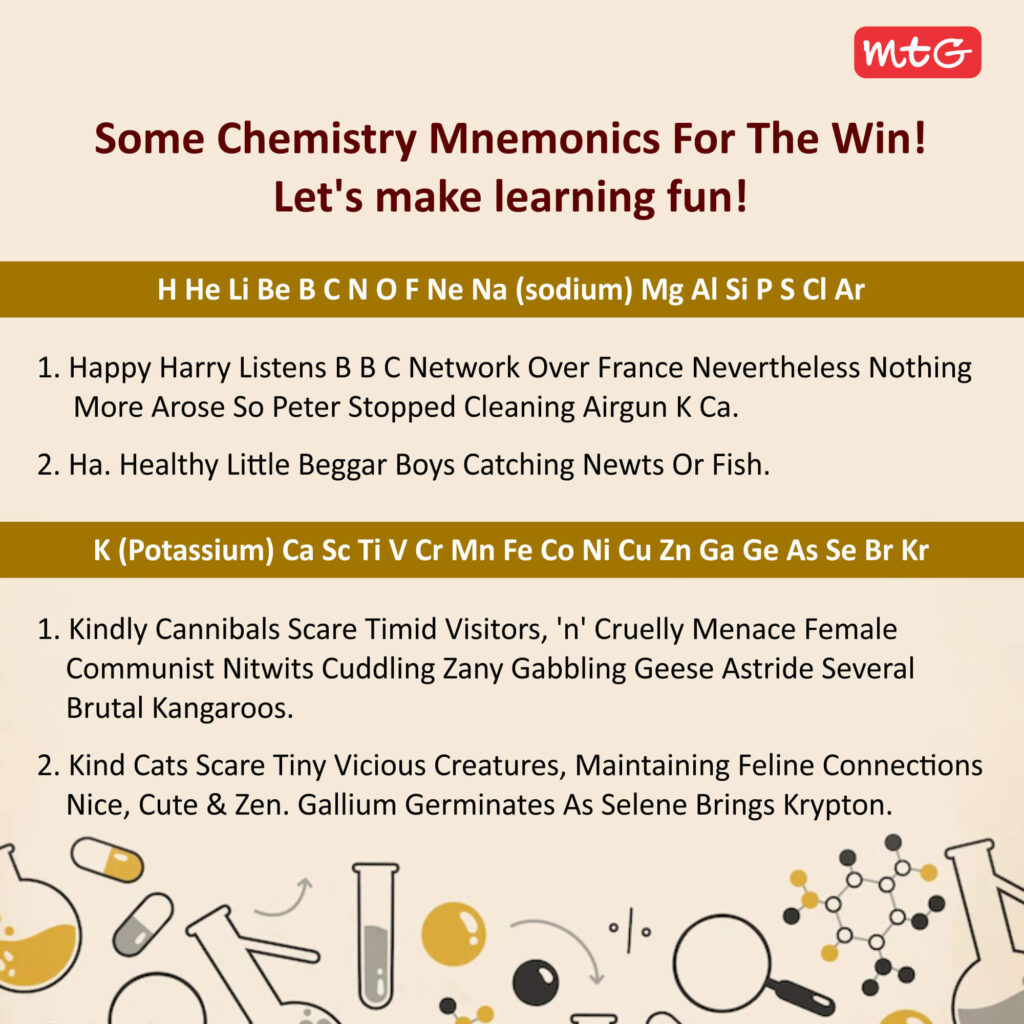
Mnemonic learning tools can help students overcome the problem they face while learning the periodic table or any other chemical reactions. It is one of the most efficient ways to memorize the periodic table in the shortest amount of time. It is a memory technique that aids in the retention of information. As the periodic table is not only vast but difficult, mnemonics could come in handy while learning and memorizing. Some examples of mnemonics are mentioned below for your help.
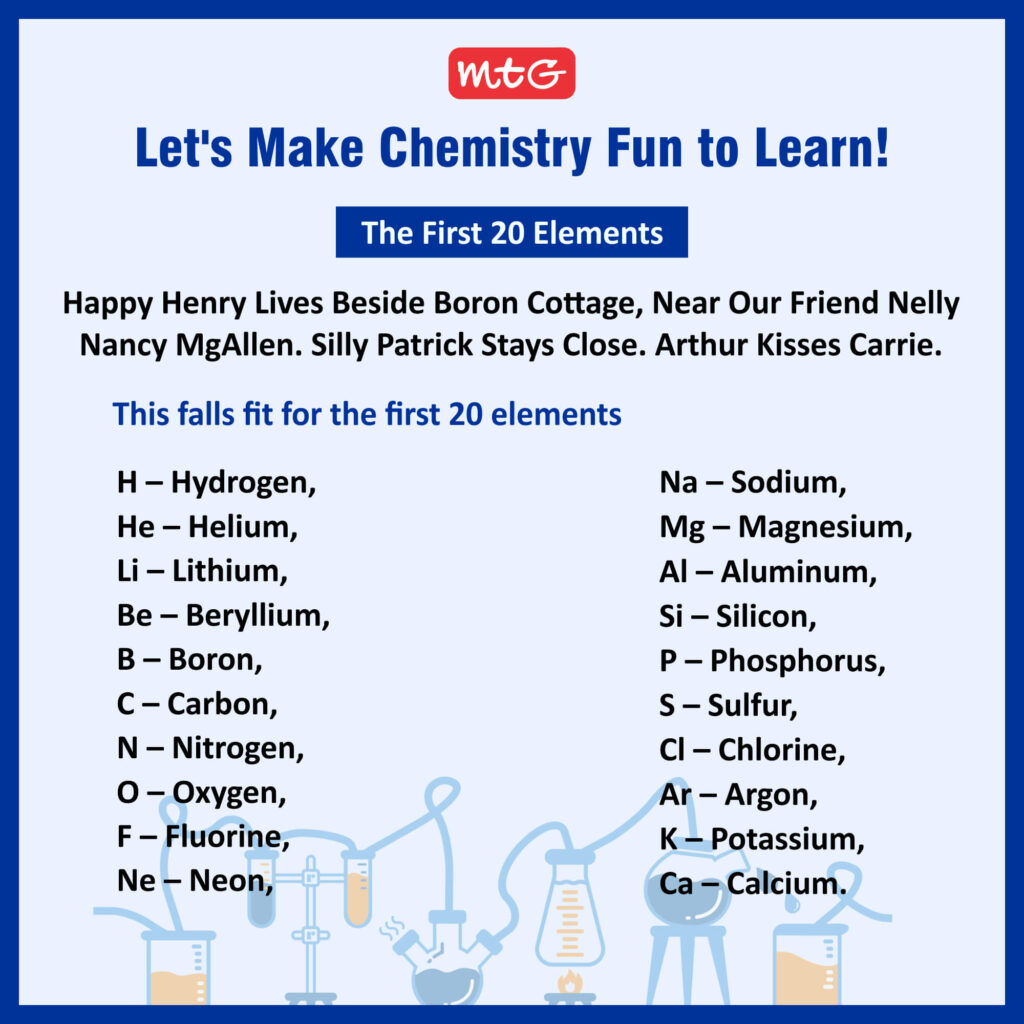
Similarly, you can create other exciting sentences and memorise the sequence of chemical names of the elements.
Practice Regularly in An Effective Manner
To learn chemical reactions, you must put in the effort and practice. However, if you use clever methods to memorise them, you will fare better. Rather than simply memorising and practising similar types of chemical reactions, try to solve as many unique and different types of chemical reactions as possible. It is preferable if you are well prepared for any difficult questions that may appear in the exam. So, try out all of the different chemical reactions and boost your topic understanding accordingly. Practicing maximum number of questions will make you look at the reactions again and again, which will ultimately and unintentionally lead to you memorising those chemical reactions.
You will also like: What are Name Reactions in Organic Chemistry for NEET & JEE Aspirants
Understand How to Balance Chemical Reactions
- Separately count the number of atoms and molecules on both sides of the reaction by making a list.
- Identify the compound with the largest atom and begin balancing it on both sides of the reaction.
- Remember not to change the chemical formulae of the compounds while balancing their numbers. Only their coefficients can be substituted.
- First, balance the compound with the most atoms in the reaction, and then gradually progress to the next one.
- Finally, describe the physical states of the reactants and products in the balanced chemical reaction.
Need preparation tips for class 10 & 12? check out
How to Prepare for CBSE Class 12 Exams?
Study Tips to Prepare for CBSE Board Exams Class 10
Use Books & Study Material/Notes Which Will Provide Concept Maps
There is only one word to say which you should understand – MTG. You can try out the best Chemistry books by MTG that provide brain maps and concept maps in the best way possible. MTG also has monthly magazines with an audience of over 1 crore avid readers. Although, you can also create concept maps yourself based on what you have studied so that you can revise it repeatedly to memorise it efficiently. However, monthly magazines like Chemistry today will provide you with a thorough concept map every month leaving no stones unturned. You can also try MTG’s 100 PERCENT, Objective NCERT At Your Fingertips and CBSE Chapterwise-Topicwise 10 Years Solved Papers which have thorough Concept and brain maps.

How to Learn Chemical Reactions?
The following are some steps that can help you learn reactions in Chemistry:
- All of the inorganic chemistry reactions and trends in that group’s periodic table need to memorised using rote learning. Of course, you will be understanding and practicing them beforehand, however, they need to mugged up in order to stick into your mind like the back of your hand.
- Examine the reactions or trends for patterns or similarities and make a note of it below that reaction.
- Take a notebook and jot down all of the chemical reactions you want to remember until the exam. This step should be repeated daily.
- Take notes on the colour of precipitates, trends in electronegativity across the group, ore names, flame test colours, and so on.
- Make concept maps if needed.
- At the end of the day, go over all of the reactions you tried to memorise during the day.
Check out: CBSE Class 12 Chemistry Syllabus for 2022-23
Ways to Predict the Product in the Inorganic Reactions
In inorganic reactions, there are several ways to predict the product.
- Examine the compound in the reaction and note its oxidation state. The oxidising agent is the compound with the highest oxidation state. The compound with the lowest oxidation state, on the other hand, acts as a reducing agent.
- Elements may attempt to achieve the most stable oxidation state in some cases. As a result, try to create the product in the most stable oxidation state possible.
- To predict the product in advance, master the periodic table, electrochemical series, and solubility of compounds topics.
Ways to Learn Named Reactions in Organic Chemistry
- The methods for learning named reactions in Organic Chemistry are as follows.
- Make a separate notebook for each of the named reactions and their mechanisms.
- Read them on a regular basis, and at the end of the day, try to write at least five reactions with their mechanisms at a time.
- Try to find examples where that reaction occurs. You can also monitor the conversion reactions. This allows you to easily find a loop between different reactions and memorise them.
Recently Launched Class 12 Sample Papers

Memorizing the chemical reactions in order to remember them for a long time is a bad idea. It is preferable to understand them rather than memorise them. Although there are some aspects that must be memorised, such as functional groups, nomenclature, reagent names, and so on, learning the entire reaction and reaction products is a difficult task. Therefore, use your mind and be efficient.